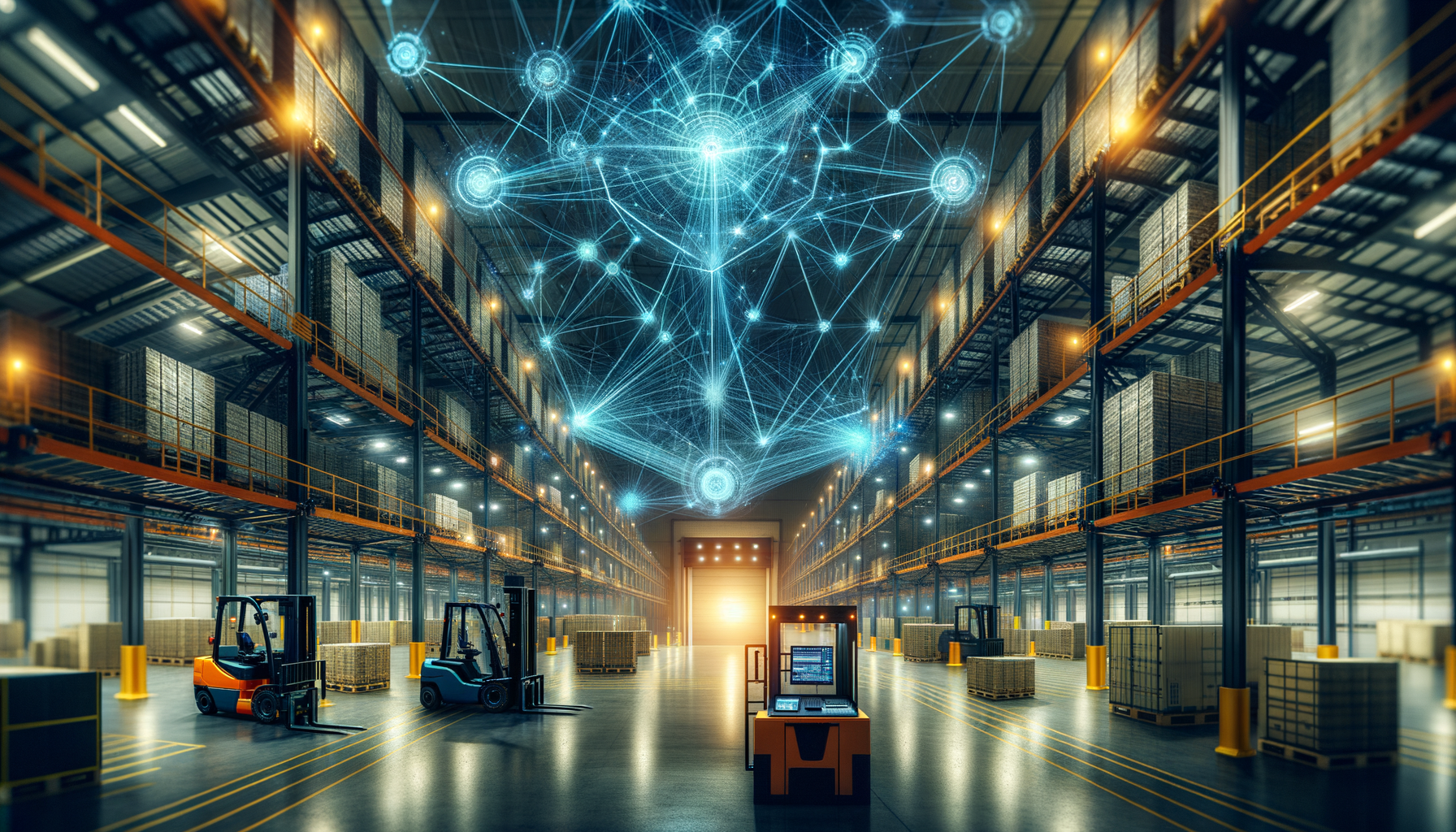
Every warehouse runs on a patchwork of systems that don't talk to each other.
Your WMS knows where inventory should be. Your LMS tracks labor hours. Your TMS manages shipments. Your HRIS holds employee records. Each system has a partial view of your operation. None has the truth.
Between these systems sits a human. A supervisor toggling between screens. An analyst pulling data from five sources into a spreadsheet. A safety manager reviewing footage after an incident already happened. The human is the integration layer, the connector, the one who makes sense of fragmented information and decides what to do next.
This is expensive. It doesn't scale. And there aren't enough people to do the work.
That's about to change. AI agents are arriving in warehouse operations. Not chatbots. Not dashboards with a chat interface. Autonomous digital workers that can reason through problems, investigate exceptions, and take action across your systems.
Here's what that actually means and why it matters now.
The Integration Problem No One Talks About
Walk into any large warehouse and you'll find sophisticated technology everywhere. Scanners. WMS terminals. Telematics on forklifts. Temperature monitors in cold storage. Dock scheduling systems. Time clocks.
Each of these systems generates data. None of them understand each other.
A simple example: Marc scans a pallet at 10:00 AM. He scans it again at 10:15 AM. Your WMS recorded both events. But what happened in those 15 minutes?
- Was there a safety near-miss?
- Did equipment malfunction?
- Was he helping another associate?
- Did a process breakdown cause delay?
Nobody knows. The enterprise stack captures transactions, not reality. It records what should happen, not what actually does.
Now multiply this across every associate, every forklift, every dock door, every shift, every site. The data exists in fragments across dozens of systems. Making sense of it requires human effort. Lots of it.
This is why supervisors spend their days in spreadsheets instead of on the floor. This is why investigations take hours instead of minutes. This is why problems get found too late, or never.
What AI Agents Actually Are
When people hear "AI" they often think of chatbots or report generators. AI agents are fundamentally different.
An AI agent is an autonomous digital worker that can:
- Reason through problems. Not just retrieve data, but figure out what data is relevant and what it means.
- Take action across systems. Pull from your WMS, cross-reference with your LMS, check the video, send a message to a supervisor.
- Handle exceptions intelligently. When something unusual happens, investigate it without being told exactly how.
- Learn from outcomes. Get better over time based on what worked and what didn't.
Traditional automation follows rules: if X happens, do Y. Agents reason: given this situation, what's the best approach?
The difference matters enormously in warehouse operations, where exceptions are the norm. Every shift brings situations that don't fit neatly into predefined workflows. A late truck. A product recall. A power outage. An operator calling in sick. Traditional automation breaks down when reality doesn't match the script. Agents adapt.
Think of it this way: a dashboard tells you what happened. An AI agent investigates why it happened, figures out what to do about it, and either handles it or brings you in with a recommendation and the evidence you need to decide.
What Agents Need to Work
AI agents aren't magic. They need three things to be useful in warehouse operations.
1. Ground Truth Data
An agent is only as good as the information it can access. Most warehouse AI projects fail here. They try to build intelligence on top of data that's incomplete, delayed, or wrong.
Your WMS knows what should be in location A3. It doesn't know if it's actually there. Your LMS says an operator completed 50 picks last hour. It doesn't know how much time was spent waiting, traveling, or dealing with exceptions.
Ground truth means continuous, accurate capture of what's actually happening on your floor. Not what someone typed into a system. Not what was supposed to happen according to the plan. What actually occurred, with video or sensor evidence to back it up.
Cameras are the most powerful sensors for this. Every other sensor gives you a single data point. A temperature. A G-force reading. A location ping. A camera captures context, sequence, cause and effect. Combined with computer vision, cameras can watch everything and surface only what matters.
2. Cross-System Access
Agents need to work across your entire technology stack. Not just one system in isolation.
When a supervisor investigates why a shipment left late, they pull data from the WMS, check the dock schedule, review labor assignments, look at equipment utilization, maybe watch some video. An agent needs the same access.
This is an integration challenge, not an AI challenge. Modern AI can reason across diverse data sources. The hard part is getting clean data flows from legacy systems that were never designed to share information.
The good news: this integration doesn't require replacing anything. The data flows one way, from your systems into an intelligence layer that sits above your existing infrastructure. You don't need a new WMS. You need a way to pull from your current one and combine it with everything else.
3. Ability to Act
Analysis without action is just another report nobody reads.
Effective agents don't just find problems. They do something about them. That might mean:
- Automatically generating a coaching plan when it detects risky behavior
- Sending an alert to the right supervisor when an exception occurs
- Creating a damage claim package with all relevant video and data
- Adjusting labor assignments when patterns indicate imbalance
- Scheduling follow-ups and tracking whether they happened
The key is defining guardrails. What can the agent do autonomously? What requires human approval? What should it never touch? The best implementations start narrow, with agents handling specific, well-defined tasks, then expand as trust builds.
Where Agents Create Value Today
AI agents aren't theoretical. They're running in warehouses right now, handling work that used to require analysts, engineers, and supervisors.
Coaching and Safety
Safety incidents rarely happen out of nowhere. They're preceded by near-misses, risky behaviors, and environmental hazards that accumulate over time. The problem is visibility. A supervisor can observe maybe 5% of what happens on their shift.
AI agents can watch everything. When they detect a near-miss or risky behavior, they don't just log it. They assemble the evidence, generate a coaching plan, notify the supervisor, schedule the conversation, and track whether it happened. What used to take hours of manual review and preparation now happens automatically.
One network reduced safety incidents by 93% using this approach. Not by adding more supervisors. By making the existing ones dramatically more effective.
Investigation and Claims
When a shipper claims their product arrived damaged, what happens? Someone spends hours digging through systems, trying to piece together what happened. Often, there's no clear answer. The claim gets paid or disputed based on incomplete information.
AI agents can investigate in minutes. They know exactly where to look, because they've been watching the entire time. Here's the video of the load being staged. Here's the footage of it being loaded. Here's the timestamp when it left the dock. The evidence exists. The agent assembles it.
This isn't just faster. It changes the economics of claims. When investigation takes hours, small claims aren't worth fighting. When it takes minutes, everything gets investigated. The behavior changes across the supply chain.
Reporting and Analysis
The dirty secret of warehouse analytics: most reports don't get read. Dashboards get built and ignored. Data sits untouched because nobody has time to analyze it.
AI agents flip this model. Instead of waiting for someone to pull a report, the agent proactively surfaces what matters. Here's an anomaly you should know about. Here's a pattern that's costing you money. Here's an opportunity you're missing.
The agent doesn't just deliver data. It delivers insight, with context and recommended action. The work of an analyst, but available 24/7 across every site in your network.
Continuous Optimization
How often do you update your engineered labor standards? Your zone configurations? Your fleet allocation? For most operations, the answer is rarely. These projects are important but never urgent. They require analysis that nobody has time for.
AI agents can run these analyses continuously. Not once a year. Every day. They can identify when standards are out of date, when slotting is suboptimal, when equipment is underutilized. They can recommend changes and quantify the impact.
This isn't replacing the work of industrial engineers. It's scaling it. One engineer with AI agents can optimize across a network that would otherwise require a team of ten.
Why This Is Happening Now
AI agents for warehouse operations didn't exist two years ago. Now they're being deployed at scale. What changed?
Technology Matured
Computer vision accuracy crossed 98% for industrial environments. Language models became capable of complex reasoning. Edge computing got powerful enough to run AI at the sensor. Inference costs dropped from dollars to fractions of a penny.
Each piece had to be in place. Vision to see what's happening. Language models to reason about it. Edge processing to work at the speed of operations. Affordable compute to scale across thousands of sensors.
Economics Shifted
Labor costs are up 3-4% annually and accelerating. There are 490,000+ open logistics positions in the US alone. Turnover runs 40%+ at many facilities. Deloitte projects 3.8 million manufacturing jobs needed by 2033, with nearly half potentially going unfilled.
You can't hire your way out of this. There aren't enough people, and those available cost more every year. AI agents offer a different path: do more with the people you have.
The Proof Points Arrived
AI in logistics was theoretical until it wasn't. Early adopters are now reporting 15% cost reductions, 35% lower inventory levels, 65% better service levels. The results are real and repeatable.
The market responded. AI in logistics is projected to grow from $26 billion in 2025 to $708 billion by 2034. By the end of 2026, 40% of enterprise applications will integrate AI agents, up from less than 5% in 2025.
This is a land grab. The companies deploying now are building data advantages, process advantages, and capability advantages that will be hard to replicate.
What This Means for Your Operation
AI agents are going to change how warehouses run. The question isn't whether, but when and how.
Here's what I'd think about if I were running an operation today.
Start with ground truth. Agents can't reason about data that doesn't exist. Before you worry about AI, make sure you're capturing what's actually happening on your floor. Continuous, accurate, with evidence you can trust.
Pick a narrow use case. Don't try to automate everything at once. Start with one specific workflow where AI agents can take a defined set of actions. Safety coaching is a common starting point. Claims investigation works well. Expand from there.
Think integration, not replacement. The best AI implementations sit above your existing systems, not instead of them. They pull data from your WMS, LMS, TMS, and everything else. They make your current investments more valuable, not obsolete.
Measure outcomes, not activity. The point isn't having AI agents. The point is getting results. Fewer incidents. Lower costs. Better service. Track what matters.
Move now, learn fast. The companies deploying AI agents today are learning things their competitors won't know for years. Early mistakes are cheap. Late adoption is expensive.
The next five years will determine which operations become benchmarks and which become cautionary tales. AI agents are how you compete when you can't hire your way to excellence.
The technology works. The economics work. The question is whether you're going to use it.
Related Articles
- What is Agentic AI? - The complete definition and framework
- How AI Agents Optimize Your Forklift Fleet - A real agent in production
- Agentic AI for Supply Chain - Agents beyond the warehouse
- The Warehouse Operating System - The platform that enables agents