AI forklift safety that sees it happen
A OneTrack sensor rides on every lift. Iris-1, our world model, catches collisions, near misses, phone use and dismounts, and every event comes with the video.


Telematics tells you something happened. OneTrack shows you what happened and why.
Forklift telematics records an impact's g-force, speed and hours. It can't see what was hit, who was involved or what led to it. OneTrack's cameras and Iris-1 can.
Forklift telematics
OneTrack
A g-force reading, with no context on what was hit or why.
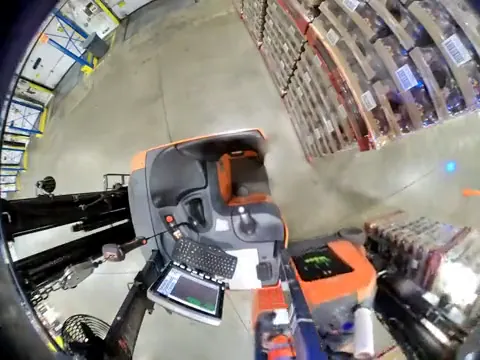
Video of what was hit, and what the operator did before it.
Potholes, dock plates and debris trigger the same alert as a real impact.
Sees whether it hit something or rolled over a crack in the floor.
Sensors can't observe it.
Phone use, not looking where it travels, seatbelts and PPE.
No impact, no reading.
Close calls with pedestrians, racking and other equipment.
A timestamp and a number. Witness statements fill the gap.
Video of the seconds before and after every event.
Among AI models, Iris-1 sees best
It accurately describes 90% of real forklift collisions, while still detecting almost all of them. General-purpose models answer “no collision” to almost every clip. Iris-1 learned the floor from one of the largest data sets of real-world operational data, hand-curated, selected, anonymized and cleaned.
How we tested Iris-1Three collisions from the test set
A second lift pulls alongside and makes contact.
- Gemini 3.8 Flash
- “No, there was no collision.”
- Iris-1
- “Yes, the lift hit another forklift.”
Another forklift drives into it from the side.
- Gemini 3.8 Flash
- “The forklift reverses and backs directly into a shrink-wrapped pallet.”
- Iris-1
- “Yes, the lift hit another forklift and hit product or a load.”
Another lift bumps the stationary stand-up truck.
- Gemini 3.8 Flash
- “It came to a stop without making contact.”
- Iris-1
- “Yes, the lift hit another forklift.”
Then the right person sees it, with the video
Serious events go to the safety lead. Coaching moments go to the operator's supervisor. Each one arrives by email, Teams or text, clip attached.
“Before OneTrack, it was difficult to truly know why incidents would occur, and our supervisors weren't able to have the quality of coaching conversations that we can now, because they didn't have video proof to back them up.”
Matt IrelandDirector of EHS, Holman Logistics Read the Holman Logistics case study
A forklift reverses into a parked, unoccupied stand-up forklift.
- Safety leadClip and impact dataSent
- SupervisorCoach the operator from the clipCoaching list
- Safety meetingReviewed with the team this weekQueued
- Event
- Rack impact
- Operator
- OP-0417
- Location
- Aisle C4
- Time
- 14:32:17
Checked against the video
- PPE wornYes
- Damage to rackingYes
- Escalation requiredYes
Every event documented automatically
The incident report fills itself in from the video, and every answer is checked against the clip. No paper forms, no late reports.
- Escalated on its own.Serious events go to safety and HR with the report and the clip.
- Reporting your way.Your own forms, checklists and reports, built on top.
- An audit trail that builds itself.Clips export for HR, OSHA or legal.
What clients see on the floor
- 70% fewer impacts and product hits
- 92% fewer phone violations
- 50%+ fewer impacts in three months
- 99% fewer phone violations
- 90% faster investigations
- 99% less phone use
- Supervisor alerts sent automatically
- Weekly safety reports written by AI
Common questions
Is this surveillance? Will operators feel like Big Brother is watching?
No. OneTrack is a coaching tool, not a monitoring system. There is no facial recognition or biometrics, and operators sign in with a QR code. It surfaces the moments worth coaching instead of hours of footage, and operators tend to value the fairness that video brings.
How is this different from our existing forklift telematics?
Telematics measures g-force, not what happened. A hard brake to avoid a pedestrian looks the same as reckless driving. OneTrack sees the event itself and sends the video with it, so you get fewer false alarms and alerts worth your time.
How long does installation take?
About 30 minutes per forklift, with no IT project. The sensors have built-in connectivity, and most sites go live within a week of receiving equipment.
Can OneTrack work in union environments?
Yes. OneTrack runs in union environments at several clients. It works best positioned as a safety and coaching tool: the video has cleared operators of unfair blame and shown process problems that were not any one person's fault.
Bring us your hardest problem.
We'll solve it together, on your data.