Warehouse safety is more than a policy—it's a culture. And one framework, introduced nearly a century ago in 1931, remains remarkably relevant for modern warehouse operations.
What is Heinrich's Triangle Theory?
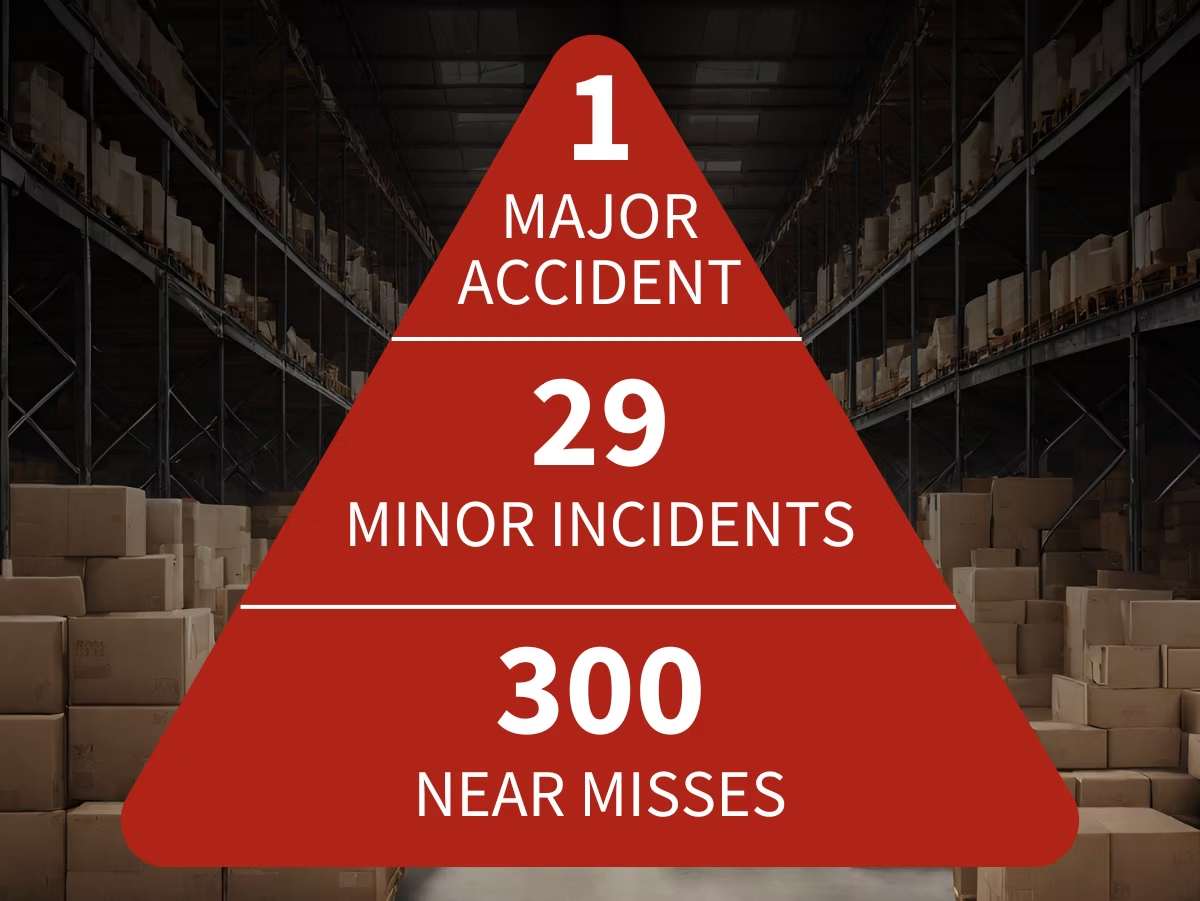
Heinrich's Triangle Theory illustrates the connections between different levels of safety incidents. According to Melody Moore, Director of EHS & Quality at Rinchem: "It shows the relationship between injuries, serious accidents, minor accidents, and near misses."
The Safety Pyramid positions near misses at its base, minor incidents in the middle, and serious accidents at the apex. The theory posits that reducing near-miss frequency decreases the likelihood of serious accidents.
Historical Context
H.W. Heinrich, an insurance company assistant superintendent, analyzed 75,000 industrial accident cases and proposed that near misses, minor injuries, and major accidents are interconnected. He theorized that reducing minor accidents correlates with decreased major accidents.
Heinrich used a domino metaphor—removing one unsafe act or condition interrupts the accident chain.
Five Key Findings from Heinrich's Research
- Incident Prediction: Lower-severity events signal potential future serious accidents
- Accident Causes: 88% resulted from unsafe behaviors, 10% from unsafe conditions, 2% from unavoidable circumstances
- Root Cause Patterns: Similar causes appear across multiple accidents; proactive analysis prevents serious events
- Behavior-Based Safety: Observing actions and applying data-driven coaching creates management-employee safety partnerships
- Organizational Involvement: Success requires buy-in from all levels
Why Near Misses Matter
Moore explains: "If you have 300 near misses, then you might have 30 minor incidents out of it, but out of those, at some point, you're going to have one major."
Addressing near misses proactively prevents severe accidents. The key insight is that the base of the pyramid—those frequent near misses—provides the earliest warning signals for potential catastrophic events.
Visibility is the Solution
Organizations cannot solve problems they cannot see. Real-time visibility through warehouse operating systems enables detection of safety incidents and unsafe behaviors 24/7, replacing time-consuming CCTV review.
Rinchem implemented OneTrack's WarehouseOS, achieving a 93% reduction in safety events within six months.
Building a Reporting Culture
Encouraging near-miss reporting requires psychological safety. Rinchem created QR codes and marketing campaigns enabling phone-based reporting, embedding the process into daily operations.
Moore emphasizes: "Think outside of the box, do things that you need to do to really engage employees because that's where the culture starts."
Collaborative Safety Programs
Successful safety policies require worker input. Moore states: "If you don't have the operational stakeholders, then the process is going to fail."
Employees embrace protocols they help shape, fostering ownership and accountability.
The Broader Cultural Impact
Effective safety culture extends beyond incident reduction—it transforms organizational operations. Moore notes that when employees influence policy development, "they want to see it succeed," creating shared responsibility where "my safety matters, but the person who works next to me, their safety matters too."
Putting Heinrich's Theory to Work
To apply Heinrich's Triangle Theory in your warehouse:
- Track near misses religiously - They're your early warning system
- Invest in visibility - You can't fix what you can't see
- Make reporting easy - Remove friction from the process
- Involve your team - Safety policies work best when workers help create them
- Coach, don't punish - Build partnerships, not fear
Want to see how OneTrack can help you apply Heinrich's principles with real-time visibility? Book a demo to learn more.