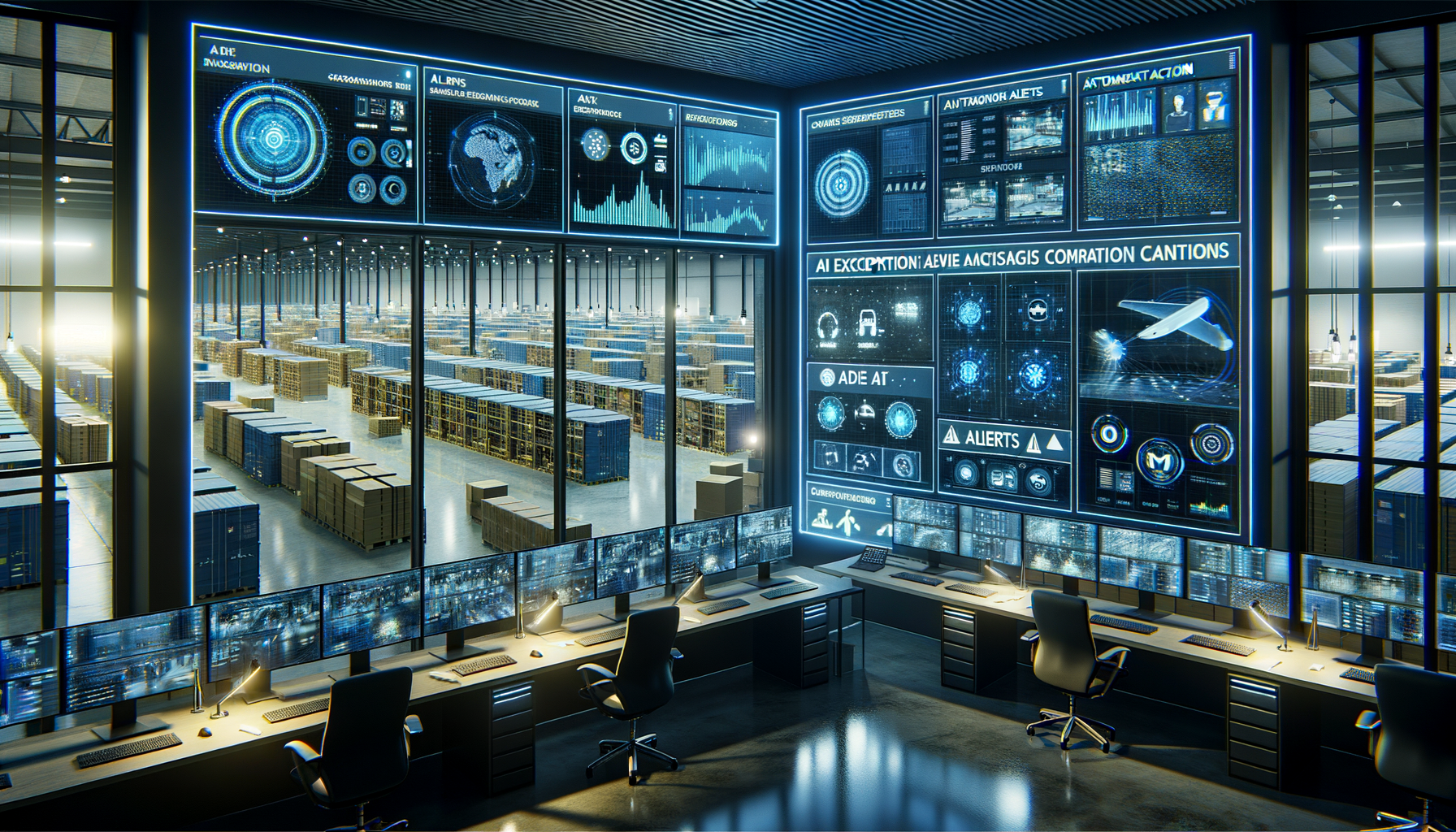
Every warehouse has dashboards. Dozens of them. WMS dashboards, LMS dashboards, safety dashboards, quality dashboards, fleet dashboards. Charts and tables and KPIs stacked on top of each other, all promising visibility into your operation.
And yet problems keep happening. Product gets damaged. Operators make the same mistakes repeatedly. Congestion builds at dock doors. Productivity drifts below target. By the time someone notices the dashboard, the damage is done.
This is the dashboard paradox: more data than ever, less time than ever to use it. The tools designed to give you visibility have become another source of noise. Another screen to check. Another report to ignore.
The next generation of warehouse technology works differently. Instead of showing you what happened, it detects what is happening and does something about it. This is the shift from passive warehouse monitoring software to active warehouse intelligence.
The Dashboard Problem
Walk into any distribution center and ask a supervisor how many dashboards they check each day. The answer is usually somewhere between "a few" and "I've lost count."
Now ask when they last had time to actually analyze what those dashboards showed. The answer is often "not recently."
This is not a training problem or a discipline problem. It is a design problem. Dashboards were built for a world where humans had time to look at them. That world no longer exists.
A typical supervisor manages 15 to 30 operators across a shift. They handle exceptions as they arise, respond to customer issues, deal with equipment problems, and try to keep the operation moving. Somewhere in there they are supposed to find time to review performance data, identify trends, and take proactive action.
They cannot. The math does not work.
So dashboards become retrospective tools at best. Weekly reviews where someone pulls last week's numbers and tries to figure out what went wrong. Monthly safety meetings where incident data gets summarized. Quarterly business reviews where executives see polished slides about trends that happened months ago.
By the time you see it on a dashboard, it is too late. The product is already damaged. The operator already quit. The customer already filed a complaint. The incident already happened.
This is not warehouse visibility. This is an autopsy.
What Real-Time Warehouse Intelligence Actually Means
Real-time intelligence is not just faster dashboards. It is a fundamentally different approach to warehouse monitoring. Instead of waiting for humans to notice problems, the system detects them automatically and takes action.
Four capabilities define the difference.
Continuous Monitoring, Not Batch Reports
Traditional analytics run on schedules. Data gets pulled nightly. Reports generate weekly. Someone reviews them when they have time.
Real-time warehouse intelligence operates continuously. Every movement, every interaction, every event gets captured and analyzed as it happens. Not in a batch at midnight. Not in a summary next week. Now.
This matters because problems in warehouses compound quickly. A bottleneck at one dock door spreads congestion through staging areas. An operator developing unsafe habits has multiple near-misses before anyone notices. A quality issue affects shipment after shipment before the pattern becomes visible.
Continuous monitoring catches these issues at the earliest point, when they are easiest and cheapest to fix.
Automatic Exception Detection, Not Threshold Alerts
Most warehouse monitoring software works on thresholds. If a number crosses a line, send an alert. Productivity below 85 percent. G-force above a threshold. Temperature outside a range.
These threshold alerts create two problems. First, they generate noise. Simple thresholds cannot distinguish between normal variation and actual problems. A forklift hitting a bump in the floor triggers the same alert as one colliding with a rack. Teams learn to ignore the alerts because most of them do not matter.
Second, threshold alerts miss context. A productivity drop might be a problem or it might be expected because of a product mix change. A safety event might be severe or minor depending on what was happening around it. Without context, alerts become guesses.
Real-time intelligence uses AI to detect exceptions that actually matter. The system learns what normal looks like in your specific operation. It understands that certain behaviors are concerning while others are routine. When it alerts, it provides the context needed to respond appropriately.
Context-Aware Analysis, Not Just Numbers
A number without context is noise. Knowing that productivity dropped 8 percent last shift tells you almost nothing. What you need to know is why.
Was it a labor shortage? Equipment problems? A difficult customer order? Process breakdown? Training gap? The number alone does not say.
Traditional dashboards leave this investigation to humans. Someone has to pull data from multiple systems, correlate timestamps, review footage if it exists, and piece together what happened. This investigation might take hours. It often never happens at all because no one has the time.
Real-time warehouse intelligence performs this analysis automatically. When it detects an exception, it immediately gathers the relevant context. Video of what occurred. Data from connected systems. Patterns from similar past events. The result is not just an alert but an understanding.
A supervisor does not get "productivity below target." They get "productivity dropped 12 percent between 2 PM and 4 PM because three operators were waiting for equipment at the north staging area. Here is the video showing the congestion. This pattern has occurred 4 times in the past week during inbound surges."
That is actionable. That can be fixed.
Autonomous Action, Not Just Notifications
The most important shift is what happens after detection. Traditional systems notify humans and wait. An alert goes out. Someone needs to see it, understand it, decide what to do, and then take action. If that person is busy, nothing happens.
Real-time intelligence can act autonomously within defined boundaries. When it detects a problem, it does not just report the problem. It initiates a response.
This is not about replacing human judgment. It is about handling the routine responses that do not require judgment. When the system detects an obvious safety violation, queuing up a coaching session is not a decision that needs human deliberation. When dock congestion is building, rebalancing assignments does not require an executive review.
Autonomous action means the system handles what can be handled, escalates what needs escalation, and keeps everything moving without waiting for humans to context-switch away from whatever else they were doing.
The Intelligence Stack
Warehouse intelligence is not a single technology. It is a stack of capabilities that work together. Each layer builds on the one below.
Capture: Seeing What Actually Happens
The foundation is ground truth data. Not what was supposed to happen according to the plan. Not what someone typed into a system. What actually occurred, with evidence to prove it.
Cameras are the most powerful capture mechanism because they preserve context. A temperature sensor tells you the temperature. A scan tells you a barcode was read. A camera tells you what was happening around that scan, how a product was handled, what an operator was doing before an incident.
AI-powered cameras placed on forklifts, dock doors, and throughout facilities create a continuous record of operations. Computer vision extracts meaningful events from this stream. Not raw footage that no one has time to watch, but specific moments that matter.
This capture layer feeds everything above it. Without accurate ground truth, intelligence has nothing to reason about.
Understand: Making Sense of Data
Raw data is not intelligence. The second layer transforms captured events into understanding.
This means AI models trained on warehouse operations. Models that recognize unsafe behaviors, detect quality issues, identify productivity patterns, and flag anomalies. Models that understand the difference between normal variation and actual problems.
Understanding also means correlation. Connecting events across systems to build a complete picture. When productivity drops, is it related to a safety event that happened an hour earlier? When quality complaints increase, is there a pattern in which operators, which products, which times of day?
The understanding layer answers the question human analysts never have time to investigate: why is this happening?
Automate: Taking Action
Intelligence without action is just a smarter dashboard. The top layer closes the loop by initiating responses.
This can mean direct automated action. Queueing coaching sessions when safety events are detected. Adjusting assignments when congestion builds. Generating documentation when quality issues occur.
It can also mean prepared recommendations. Assembling the evidence, suggesting a response, and presenting it to a human for approval. The system does the work of investigation and analysis. The human makes the final call.
The automation layer is where warehouse intelligence delivers ROI. Not by being interesting but by doing work that otherwise would not get done.
Intelligence in Action
Abstract capabilities matter less than concrete results. Here is what real-time warehouse intelligence looks like in practice.
Dock Congestion
A traditional approach: A supervisor notices that trucks are backing up. They walk out to investigate, see that three dock doors have no activity while others are overwhelmed, and start reassigning workers. By the time assignments are adjusted, an hour of delay has accumulated.
With real-time intelligence: The system detects that inbound volume is spiking at certain doors while others sit empty. It automatically rebalances labor assignments to distribute the load. Supervisors receive a notification that adjustments were made. Trucks keep moving.
The difference is not just speed. It is that the response happens at all. Without automation, the supervisor might have been dealing with something else entirely. The congestion might have built for hours before anyone noticed.
Safety Events
A traditional approach: An operator has a near-miss. If anyone sees it, maybe it gets reported. More likely, nothing happens until there is an actual incident. Then someone reviews camera footage, if the camera captured it, and tries to figure out what happened.
With real-time intelligence: The system detects the near-miss as it occurs. It captures video from the operator's perspective. It assesses the severity based on the context, checking if there were pedestrians nearby, if product was at risk, if this operator has a pattern. It queues a coaching session with all relevant evidence attached. The supervisor gets a prepared coaching package instead of a vague report to investigate.
The difference is that near-misses become coaching opportunities instead of ignored warning signs. The system does the investigation work that humans never have time for.
Productivity Decline
A traditional approach: End-of-week reports show that one shift consistently underperforms. A manager schedules a meeting. People speculate about causes. Maybe they look at some data. More likely, nothing changes.
With real-time intelligence: The system detects that productivity is dropping 15 minutes into a shift pattern. It investigates automatically, correlating the drop with equipment availability, labor distribution, product mix, and process bottlenecks. It identifies that operators are consistently waiting for replenishment in zone C during the first hour. It recommends adjusting the replenishment schedule or reallocating pickers.
The difference is root cause analysis that actually happens. Not weeks later in a meeting but in time to fix the next shift.
Why This Matters
Real-time warehouse intelligence is not about replacing supervisors. It is about making them dramatically more effective.
Supervisor Leverage
A supervisor cannot watch 30 operators simultaneously. They cannot analyze every dashboard. They cannot investigate every anomaly. They have to prioritize, which means most things go unaddressed.
AI does not have these constraints. It can monitor every operator, every movement, every event. It can analyze everything simultaneously. It can investigate every exception.
The supervisor becomes the exception handler for the exceptions. The system handles routine monitoring and response. The human handles situations that require judgment, relationships, and creativity. This is not fewer supervisors. It is supervisors who can actually focus on high-value work.
Consistent Execution
Warehouse operations are variable by nature. Different shifts, different supervisors, different approaches. What gets enforced on day shift might slide on nights. What one supervisor prioritizes, another ignores.
This inconsistency creates gaps. Safety standards vary. Quality standards vary. Productivity expectations vary. Operators learn to adapt their behavior to who is watching.
Real-time intelligence provides consistent monitoring regardless of shift or supervisor. Standards get enforced the same way every time. Coaching follows the same process. Exceptions get the same response. This consistency compounds over time into a fundamentally different operation.
24/7 Coverage
Most operations run more hours than their leadership can cover. Night shifts have minimal supervision. Weekends have skeleton crews. Holidays have nobody watching.
Incidents do not respect the schedule. Quality issues happen at 3 AM. Safety events happen on Sundays. Productivity problems do not wait for Monday.
Automated intelligence provides the same coverage at midnight as at noon. It monitors, detects, and responds regardless of whether a human is watching. Problems that would have festered for hours get addressed immediately.
The Shift Has Started
Warehouse operations are at an inflection point. The technology to move from dashboards to autonomous intelligence exists today. The economics work today. Early adopters are already seeing the results.
The companies that figure this out first will operate at a fundamentally different level than their competitors. Not incrementally better. Structurally different. More responsive, more consistent, more efficient.
The question is not whether this shift will happen. It is whether you will lead it or follow it.
Dashboards had their moment. They solved the problem of visibility when the alternative was no visibility at all. But we have more data than ever and less time than ever to use it. The next generation of warehouse intelligence does not wait for humans to look at charts. It watches, understands, and acts.
That is what real-time warehouse intelligence means. Not faster reports. Not better visualizations. Autonomous action that turns data into results.
Related Articles
- What is Agentic AI? - The AI that takes autonomous action
- AI-Powered Labor Management - Intelligence applied to workforce
- The Warehouse Operating System - The complete intelligence stack
- AI Agents for Warehouse Operations - Agents that act on intelligence